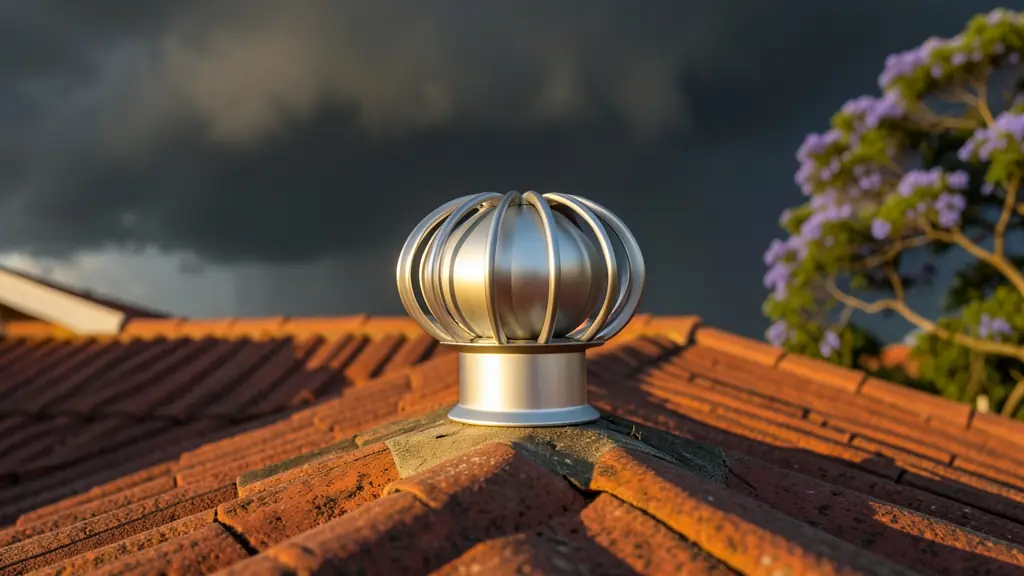
A whirlybird is a roof air ventilator with no motor: a round head of curved vanes on a bearing, sitting over a throat that opens into the roof space, on a base shaped to the roof covering. Wind turns the head, the spinning vanes draw air up the throat, and hot air rising off the ceiling helps it along. In a Pretoria East roof space that reaches 50 °C on a January afternoon, a few well placed whirlybirds with enough eave intake can take the edge off the heat that soaks down into the bedrooms.
What a whirlybird actually does
It changes the air in the roof space, nothing more. Hot, stale or damp air goes out at the top and cooler outside air comes in low. That helps with a baking roof, with condensation on cold Highveld mornings and with the musty smell of a closed roof in KZN humidity. It does not cool the rooms directly: the ceiling insulation keeps heat out of the house, the turbine keeps the space above it from turning into an oven. You want both. A common mistake in Durban North is fitting a turbine to cure mould on a bathroom ceiling while the extractor fan still blows steam into the roof space; duct the fan outside first.
Galvanised, aluminium or a coloured head
- Galvanised steel is the common, lower cost head. Fine inland, but it rusts in time near the sea or under fumes.
- Aluminium is lighter, spins in a softer breeze and does not rust, so it suits Durban, the Garden Route and the Cape coast.
- Powder coated heads in charcoal, red or brown blend with the roof. Ask whether the coating sits on galvanised or aluminium underneath.
No intake, no airflow
A whirlybird can only pull out what gets in. If the eaves are closed, it sucks air from the house through downlight holes, the trapdoor and gaps round the cornices, which takes your cooled air with it. Most houses need eave vents or open soffits added at the same time, roughly half the vent area low and half high. The whirlybird calculator gives a count of turbines and the intake to match from your roof size.
Which roofs suit one, and who fits it
Concrete and clay tiles, IBR, corrugated iron and many fibre cement roofs all take a turbine on a base made for that profile. Very low pitched and flat roofs need a different base or a different vent; see types of roof vents. Sizes are named by the throat, explained on turbine ventilator sizes, and the fitting steps are on whirlybird installation.
What to put in your request
- Give the house footprint in m² and the roof covering
- Say how many turbines or vents are there now
- Mention whether the eaves are open or closed
- Say if you live within a few km of the sea
- Note solar panels or a geyser in the roof space
Whirlybird Roof Ventilators: who asks for them and why
- Homeowners and DIY: a cooler roof space above upstairs bedrooms and less damp in a closed ceiling void
- Roofers and roofing contractors: turbines added to a reroof quote, with the base matched to the new tiles or sheets
- Builders, developers and architects: ventilators specified on a new house plan together with the eave intake they need
- Factories, warehouses and workshops: small and medium heads over workshops, stores and plant rooms with no power to spare
- Offices, shops, restaurants and gyms: heat let out of the roof over shops, offices and a church hall let for functions
- Farms, poultry houses and packsheds: turbines on a feed store, a tack room or a farm cottage with a hot tin roof
- Schools, clinics, churches and halls: a cooler roof over classrooms, clinic waiting rooms and community halls
- Landlords, body corporates and estate managers: one specification of head and base across all the units in a complex