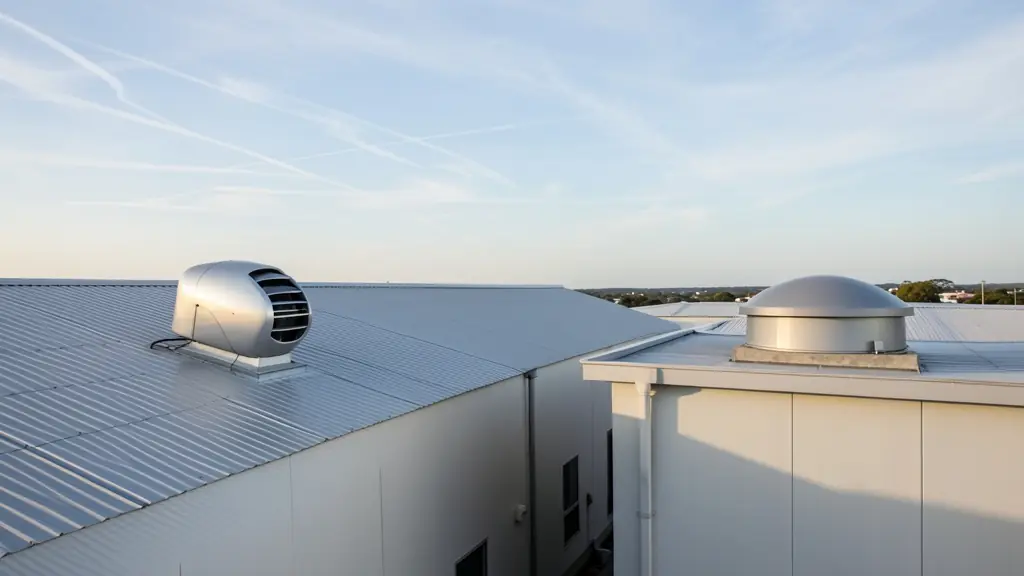
Turbine ventilator vs exhaust fan is the choice most people face once they know their roof space or building needs air out. A turbine, the whirlybird, is spun by wind and rising heat and costs nothing to run. An exhaust fan, on the roof or in a wall, is driven by a motor and pulls a set airflow on demand. A homeowner in Centurion, a panel beater in Germiston and a warehouse manager in Pinetown will each land on a different answer. The table and sections below show why.
Side by side
| Point | Turbine ventilator | Powered exhaust fan |
|---|---|---|
| Running cost | None | Electricity for every hour it runs |
| Airflow in wind | Good, rises with wind speed | Steady, as rated |
| Airflow in still air | Low, stack effect only | Full rated airflow |
| Load shedding | Unaffected | Stops unless on an inverter or generator |
| Control | None, it turns when it turns | Thermostat, humidistat, timer, switch |
| Noise | Quiet, squeals when bearings wear | Motor hum, louder at high speed |
| Upkeep | Bearings every few years, check after storms | Motor, bearings, cleaning the blades |
| Fitting | Roofer, one hole and a base | Roofer plus an electrician and a CoC |
| Suits | House roof spaces, sheds, big steel roofs | Bathrooms, kitchens, fumes, still sites |
Airflow: what the numbers hide
A turbine's airflow on the maker's data sheet is always at a stated wind speed. On a gusty Bloemfontein afternoon it can beat a small fan; on a windless KZN night in February it barely turns, and that is when the roof is still hot and the air is damp. A fan's rated m³/h is measured against little resistance, and long ducts or a missing intake cut it down. Use the air changes calculator to set the airflow you need, then check which option delivers it in the weather you get.
Where each one wins
- House roof space: turbines with eave vents, usually. A fan helps on a long roof in a sheltered, still suburb.
- Bathroom or kitchen: a fan, ducted outside. A turbine cannot clear steam on demand. See bathroom extractor fans.
- Workshop with welding or spray fumes: a powered fan with local extraction at the source.
- Warehouse heat: banks of turbines and big wall openings often do the bulk, with fans where staff stand. See industrial extractor fans.
Why not both on one roof space
A fan creates suction in the roof space. If a turbine sits in the same space, the path of least resistance is down through the turbine, so the fan pulls outside air in through it and skips the eaves altogether. You pay for electricity to move air in a small loop. Pick one exhaust method per roof space, give it enough intake, and use a fan only in rooms that are ducted separately. A solar fan sits in between: see solar roof ventilators.
What to put in your request
- Say what the space is: roof space, room or shed
- Give the floor area and the height
- Say how windy or sheltered the site is
- Say if you have an inverter or generator
- Ask for both options priced if unsure
Turbine Ventilator vs Exhaust Fan: who asks for them and why
- Homeowners and DIY: deciding between a whirlybird and an electric fan for a hot upstairs roof space
- Roofers and roofing contractors: pricing a turbine option and a fan option so the client can compare running costs
- Builders, developers and architects: choosing passive exhaust for the roof and ducted fans for the wet rooms
- Factories, warehouses and workshops: turbines for general heat under the roof and powered fans for fumes and welding bays
- Offices, shops, restaurants and gyms: restaurants and gyms that need a fan for smells and sweat, not just a turbine
- Farms, poultry houses and packsheds: naturally ventilated sheds on turbines against tunnel houses on big fans
- Schools, clinics, churches and halls: school halls where a turbine runs free and a fan would add to the power bill
- Landlords, body corporates and estate managers: a body corporate weighing upkeep and electricity across many roofs