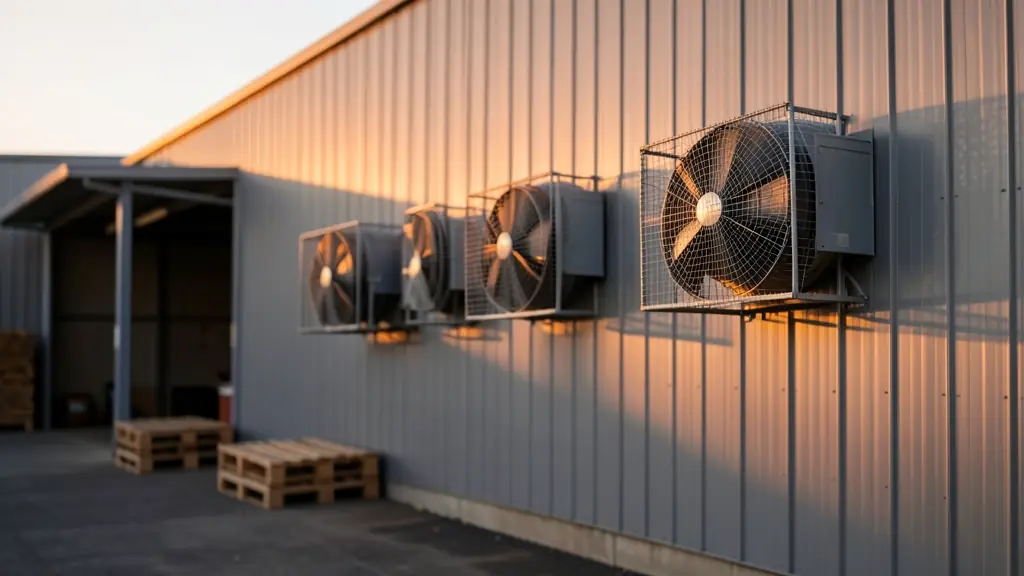
An industrial extractor fan is a large axial or roof mounted fan that changes the air in a whole building: a warehouse under a hot steel roof, a workshop, a laundry, a bakery or a bottling line. Where turbines only work as fast as the wind, these fans move a known volume every hour, so staff in a Germiston distribution centre or a Rosslyn assembly hall get relief on the hottest afternoons. This page covers sizing, mounting, power, noise and what has to be in the quote.
Sizing by air changes
Start from the volume: floor area times the average height. Then pick the air changes an hour for the use. A dry goods store needs far fewer than a laundry, a paint store or a foundry. Multiply the two and you have the total airflow in m³/h, which you then split across several fans so the whole floor is swept. The air changes calculator does this in one step and suggests a fan count. Check each fan's figure on the maker's data sheet at the pressure it will actually work against, with the shutter and guard on.
Wall or roof, and where the air comes in
- Wall fans go high on the side or end walls, are easy to reach for service and suit long sheds where air can cross from one side to the other.
- Roof fans sit on an upstand on the sheeting and take the hottest air straight from the apex, a good choice on wide buildings.
Whatever the mounting, the air has to come from somewhere: open roller doors, wall louvres or inlet grilles on the opposite side. Without enough inlet the fans labour and doors whistle. Gravity shutters close when a fan stops, so rain and birds stay out, and guards are needed wherever a fan is in reach.
Power, noise and fumes
Big fans often run on three phase power, smaller ones on single phase. Either way a registered electrician installs the cabling, the isolators and any speed controller, then signs off a CoC. Ask for the sound level at a stated distance if people work close to the fans. For welding fume, solvent or dust, general extraction is not enough: those need local extraction at the source, designed by a specialist. Turbines on the same roof as powered fans fight them, so read industrial turbine ventilators before mixing the two.
Upkeep and hire
Belt driven fans need belts checked and tensioned, bearings greased and blades cleaned, because dust on a blade cuts airflow and unbalances it. Direct drive fans need less. For a marquee, a stocktake or a short hot spell, mobile fans can be hired instead of fixed units.
What to put in your request
- Give the floor area and eaves and apex height
- Describe what happens in the building
- Say if there is three phase power nearby
- List doors and openings that could be inlets
- Mention fumes, dust or steam at the source
Industrial Extractor Fans: who asks for them and why
- Homeowners and DIY: a big fan in a home workshop, a large garage or a double volume entertainment room
- Roofers and roofing contractors: cutting and flashing upstands for roof fans on IBR during a factory reroof
- Builders, developers and architects: fan positions, inlets and power planned into a new warehouse before the cladding goes up
- Factories, warehouses and workshops: clearing heat from an assembly hall, foundry, plant room or packing line all shift
- Offices, shops, restaurants and gyms: extracting heat and steam from a laundry, bakery, gym hall or busy kitchen
- Farms, poultry houses and packsheds: end wall fans in a packshed, a dairy parlour or a farm workshop on hot days
- Schools, clinics, churches and halls: moving air through a school hall, a church hall or a municipal workshop
- Landlords, body corporates and estate managers: a facilities manager planning fans for a multi tenant industrial park