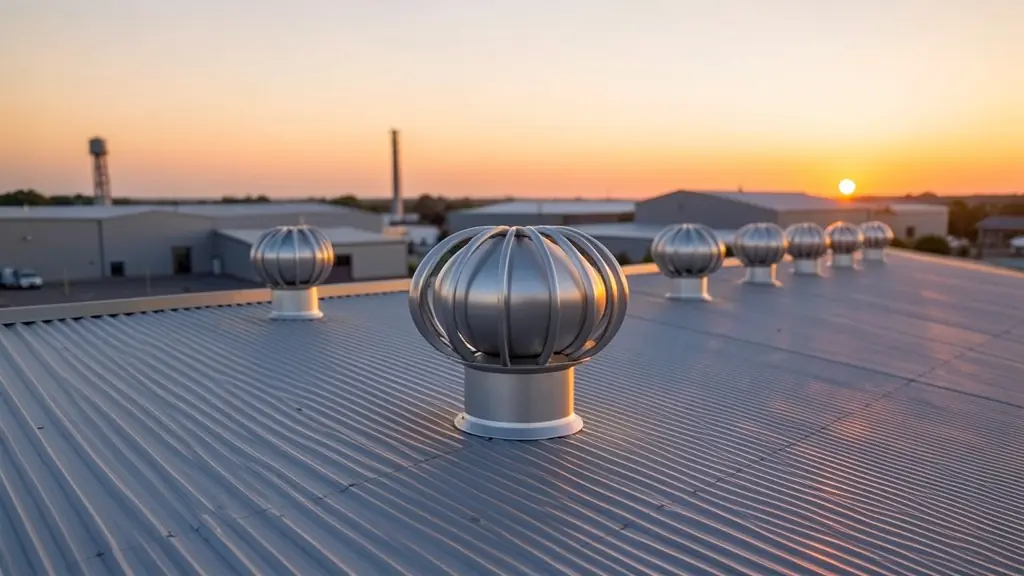
An industrial roof ventilator is a heavy duty turbine, usually 450 to 600 mm at the throat, fitted in rows along the ridge of a factory, warehouse, workshop or hall. Under 6,000 m² of bare steel in Germiston or Rosslyn the air below the roof can sit well above the outside temperature by midday, and staff feel it. A bank of turbines lets that layer of hot air escape all day without a single kilowatt, as long as fresh air can get in lower down.
Why big steel roofs need them
Sun on IBR or corrugated sheeting heats the metal, the metal heats the air under it, and in a tall shed that hot layer builds up over the racking or the production line. Workers slow down, stock like paint, chocolate or seed suffers and forklift batteries run hot. Turbines along the ridge sit right where that air collects. They do not cool below the outside temperature, but they stop the build up. A common mistake is spreading turbines evenly over the whole roof when the heat comes from one end, say a bakery oven line or a compressor room; put more heads over the hot zone.
Heavy duty heads, bearings and materials
- Ask for heavy duty bearings rated for constant running, and a braced head that holds its shape in a Highveld storm.
- Aluminium or stainless heads suit the coast in Durban, Richards Bay or Gqeberha and plants with acid or salt in the air. Galvanised rusts there.
- The base must match the sheet profile and pitch; a mismatched base on a long roof leaks along every rib.
Intake, spacing and how many
Air must enter low: wall louvres, open roller doors, a gap at the eaves or a vented side cladding strip. A warehouse with every door shut at night gets little from its turbines. Spacing runs along the ridge, often in one or two rows, and the count comes from the building volume and the air changes an hour you want; the air changes calculator gives a starting figure. A powered option is on industrial extractor fans.
When turbines are not enough, and working at height
Welding fumes, paint spray, grain dust and solvent vapour need extraction at the source and usually a powered system designed for it. Turbines only help with general heat. Fitting is work at height on fragile sheets: the contractor brings fall protection, crawl boards or a cherry picker, and the owner or employer has duties under the Construction Regulations. Never cut into an old asbestos cement roof; that is for a registered asbestos contractor. See roof ventilation installers.
What to put in your request
- Give the floor area, eave height and ridge height
- Name the sheet profile and say if it is asbestos
- Describe the work under the roof: storage, welding
- List wall louvres, doors and other openings
- Say how close the site is to the coast
Industrial Turbine Ventilators: who asks for them and why
- Homeowners and DIY: a large home workshop or double volume garage with a bare steel roof
- Roofers and roofing contractors: rows of heavy duty heads priced into a factory reroof in IBR or corrugated
- Builders, developers and architects: ridge turbines and wall louvres drawn into a new warehouse or retail shell
- Factories, warehouses and workshops: heat let out over production lines, racking and loading bays all day
- Offices, shops, restaurants and gyms: turbines over a hardware yard, a showroom or a sports hall
- Farms, poultry houses and packsheds: turbines on packsheds, grain stores and machinery sheds with no spare power
- Schools, clinics, churches and halls: a cooler roof over a municipal depot, a church hall or a school gym
- Landlords, body corporates and estate managers: a planned replacement of rusted heads across an industrial park