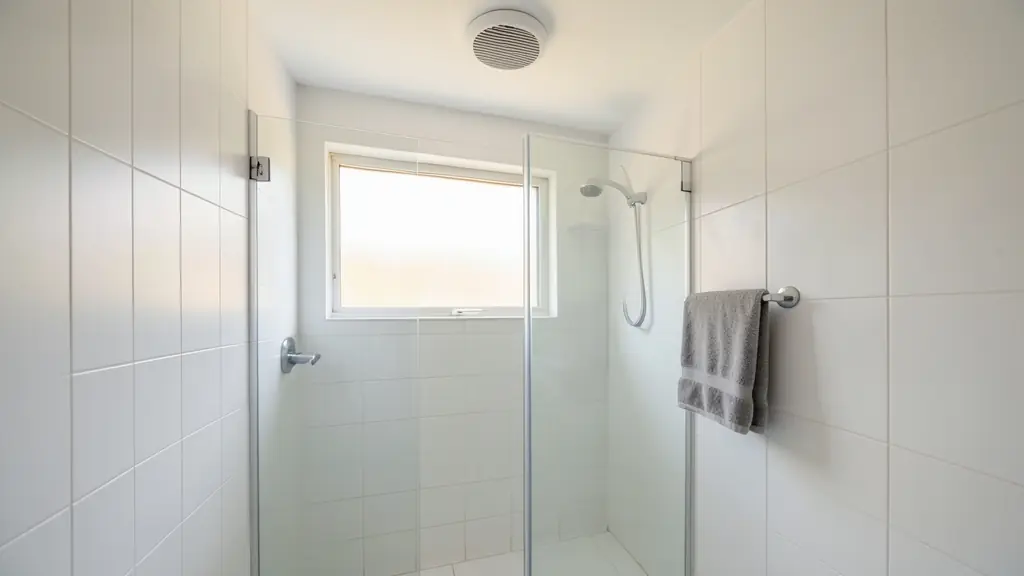
A fan that is too small leaves mould on the ceiling; one on too narrow a duct whistles. This calculator gives the airflow to ask for and the duct to match. Read about choosing and wiring the fan on bathroom extractor fans, getting a cooker hood out through the roof on kitchen roof vents, and the outlet on the roof on roof vent caps.
Air changes or the minimum, whichever is higher
The room volume x air changes an hour gives one airflow. Bathrooms are usually given 6 to 10 air changes, toilets 3 to 6, home kitchens 15 or more. Building codes also set a minimum extract rate per room: South Africa's older national building code table gives 25 l/s for a bathroom, shower room or toilet in a home and 50 l/s for a kitchen, the same figures New Zealand uses today. For a laundry the tool uses a UK figure, 30 l/s. The higher wins, plus 10% for duct leaks.
Example: a bathroom 2.5 x 2 m with a 2.4 m ceiling holds 12 m³. At 8 air changes that is 96 m³/h, or 26.7 l/s, just above the 25 l/s minimum. With 10% added, ask for a fan of about 106 m³/h. A 100 mm duct carries that at about 3.4 m/s.
Choosing the duct
Duct speed = airflow / the duct's cross section. A design guide recommends about 3.5 m/s in a branch duct and no more than 5 m/s; faster means noise and lost airflow. Small ceiling fans usually have a 100 mm outlet, bigger ones 150 mm. A kitchen at 15 air changes can outgrow a 150 mm duct: follow the hood maker's duct size and keep the run short.
What makes a fan work in practice
- Duct it to the outside through a roof cap or a wall or eave outlet with a flap, never into the roof space.
- Keep the duct short, with few bends, and rigid where you can.
- A run on timer or humidistat clears the steam after the shower.
- A fixed fan on the lights circuit is wired by an electrician, who issues the CoC.
Frequently asked questions
Does every bathroom need an extractor fan?
Can the duct end in the roof space?
Why does my fan move less than the box says?
Who will quote for the fan and the ducting?
More calculators
- Roof vent area calculatorCeiling area in, the net free vent area and the eave and high vents to fit out
- Whirlybird calculatorRoof size and turbine size in, how many whirlybirds and the eave intake out
- Air changes calculatorBuilding size and use in, the airflow in m³/h and how many fans or turbines out
- Roof pitch and area calculatorFootprint and pitch, or rise and run, in: pitch in degrees and the sloped roof area out
- Ventilation cost estimatorTurbines, fans, vents and labour in, a rough rand budget from published prices out