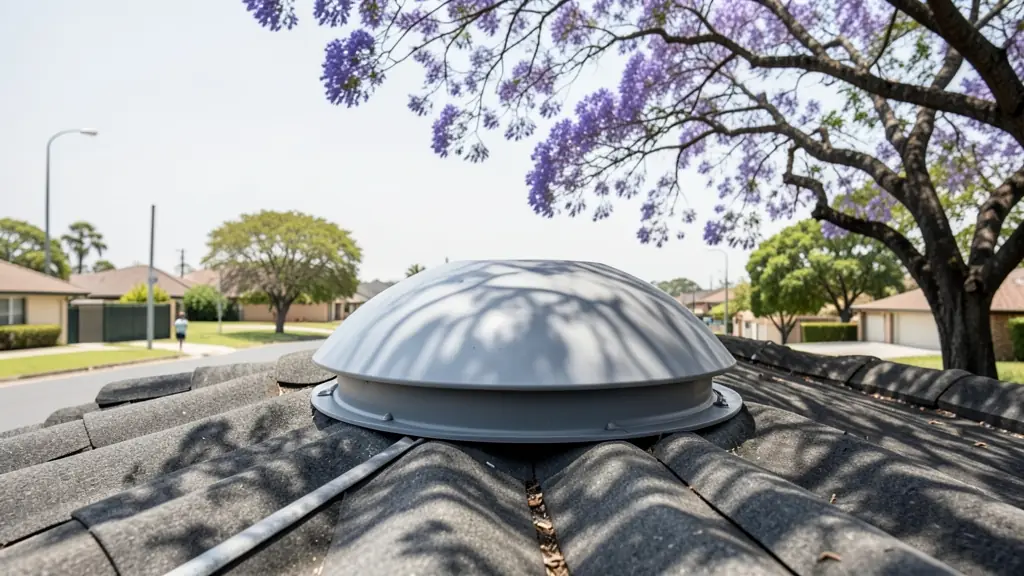
A roof extractor fan is an electric fan that pulls hot or damp air out of the roof space and pushes it outside, either through a low cowl on the roof or through a gable wall. Unlike a whirlybird it does not wait for a breeze: on a still January afternoon in Centurion, when the tiles are baking and nothing is moving, the motor keeps drawing air. Here is how the main kinds work, what they need around them and what to ask an installer before you sign anything.
Cowl fans, in roof fans and gable fans
- Roof cowl fans sit on the roof like a squat dome, with the motor under the hood and a flashing to suit tiles or sheeting.
- In roof fans hang from a truss inside the ceiling void and blow out through a vent tile, a gable louvre or a short duct to a cap.
- Gable fans mount behind a louvre in the end wall, which keeps the roof covering intact, handy on an old clay tile roof that cracks when walked on.
Most come with a thermostat that starts the fan at a set roof space temperature, and some with a humidistat for damp coastal roofs.
Airflow, noise and the power supply
Fans are rated in m³/h, and that figure is usually measured with nothing in the way. Ask for the airflow with the cowl or louvre fitted. A bigger fan at low speed is often quieter than a small one at full speed, which matters above a bedroom ceiling. The cable from the board to the fan is fixed wiring, so a registered electrician runs it and hands you a CoC afterwards. During load shedding a mains fan stops unless it runs off an inverter, and a roof fan is a low priority load, so many owners leave it off the backup circuit. The air changes calculator gives a starting airflow from the roof space volume.
The intake decides whether it works
A fan can only move as much air as it can draw in. With closed eaves and no vents low down, it sucks conditioned air out of the house through downlight holes, the hatch and gaps round the cornice. Plan eave vents or soffit vents with enough free area before the fan goes in. And never run a powered fan in the same roof space as a turbine: the fan simply pulls air down through the turbine throat, a few metres away, and the rest of the roof stays hot.
Where a fan beats a turbine
- Sheltered sites, such as a townhouse in a dense complex where neighbours block the wind.
- Long or low pitched roofs where one head near the ridge cannot reach the far end.
- A roof space that must be cleared on demand, for example over a gym or a server cupboard.
On an open, breezy plot a turbine often does the job without power. The turbine versus exhaust fan page compares the two.
What to put in your request
- Give the house footprint and roof covering
- Say whether the roof has turbines now
- Mention closed or open eaves
- Say if a backup inverter is installed
- Ask for the fan, flashing and wiring together
Roof Extractor Fans: who asks for them and why
- Homeowners and DIY: clearing a baking roof space over upstairs bedrooms on a still Highveld summer day
- Roofers and roofing contractors: fitting a cowl and flashing on a reroof, with the electrician booked for the wiring
- Builders, developers and architects: specifying a powered fan for a townhouse block where the wind barely reaches the roofs
- Factories, warehouses and workshops: extracting heat from the void above an office block inside a factory yard
- Offices, shops, restaurants and gyms: keeping the ceiling void over a gym, salon or shop cooler during trading hours
- Farms, poultry houses and packsheds: drawing hot air from the roof of a farmhouse or a farm office with a long low roof
- Schools, clinics, churches and halls: clearing heat above a school staffroom or clinic ceiling where turbines would not reach
- Landlords, body corporates and estate managers: one fan type for every unit in a complex, wired and certified by one electrician
Frequently asked questions
Will a roof extractor fan cool my rooms?
Can I keep my whirlybird and add a fan?
How many fans does a house need?
Who will quote me?
Work it out first
- Roof vent area calculatorCeiling area in, the net free vent area and the eave and high vents to fit out
- Whirlybird calculatorRoof size and turbine size in, how many whirlybirds and the eave intake out
- Air changes calculatorBuilding size and use in, the airflow in m³/h and how many fans or turbines out