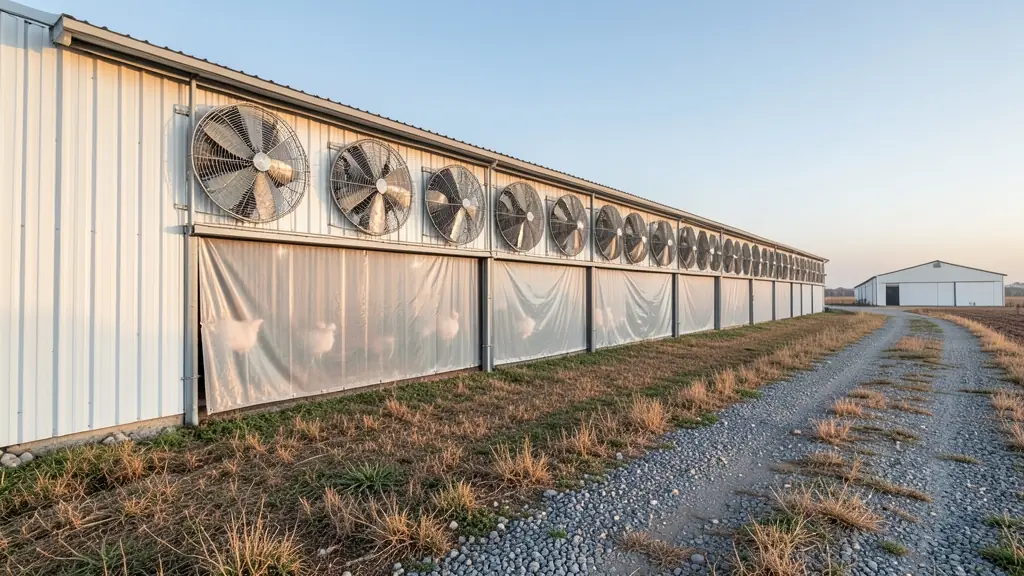
Poultry house ventilation is a production system, not a comfort extra. A broiler house near Bethal, a dairy outside Mooi River or a piggery in the Free State lives or dies on how fast heat, moisture and ammonia leave the building. Get it wrong for one hot afternoon or one long power cut and you lose animals. This page covers the main approaches for farm buildings, from tunnel fans to ridge vents, and what to settle with the supplier before they quote.
What the air has to carry out
Animals give off heat and water all day, and manure gives off ammonia that hurts lungs and eyes. In winter the job is minimum ventilation: enough fresh air to keep ammonia and damp down without chilling the birds. In summer it is maximum airflow, moving air fast over the animals to take heat off them. A packshed or a cold store anteroom has a different aim: keeping produce cool and dry and the forklift fumes out.
Tunnel, cross and natural ventilation
- Tunnel ventilation. Large fans in one end wall pull air the length of the house from inlets at the far end, which gives a fast wind over the birds. Common in closed broiler and layer houses.
- Cross or side inlet ventilation. Fans on one side or the end, with adjustable inlets along the side walls for winter.
- Natural ventilation. Open sides with curtains, plus ridge vents or a bank of turbines along the top, for dairies, stables and older open sheds. It depends on wind and on the shed facing the right way.
The airflow for the building's volume is a starting figure in the air changes calculator. See also industrial extractor fans and ridge vents.
Power, backup and controls
A closed house full of birds can overheat quickly when the fans stop. Plan for load shedding and faults: a generator sized for the fans with an automatic changeover, alarms that phone the farmer, and curtains or drop panels that open on a power failure. An electrician wires the fans and the changeover and issues a CoC. Controllers that stage the fans by temperature save power on mild days.
Who to ask besides the supplier
The animal production adviser, the integrator you grow for or your vet will have views on air speed, minimum ventilation and stocking, and those come before the fan count. Ask the supplier for a written layout showing fans, inlets, curtains and controls, not just a list of fans.
What to put in your request
- Give the shed length, width and wall height
- Say which animals or crop and how many
- Say open sided or closed house
- Describe the power supply and any generator
- Ask for a layout drawing with the quote
Farm Building Ventilation: who asks for them and why
- Homeowners and DIY: a smallholding chicken run or stable that bakes under a bare steel roof
- Roofers and roofing contractors: fitting ridge vents and turbines along a new dairy or stable roof
- Builders, developers and architects: putting up a new poultry house with the fan wall and inlets planned in
- Factories, warehouses and workshops: a packhouse or feed mill where heat and dust build up under the roof
- Offices, shops, restaurants and gyms: an agricultural supplier fitting fan walls for growers in the district
- Farms, poultry houses and packsheds: broiler and layer houses, piggeries and dairies that need steady airflow
- Schools, clinics, churches and halls: an agricultural college or research farm ventilating its teaching sheds
- Landlords, body corporates and estate managers: a farm estate or equestrian estate with rows of stables and barns