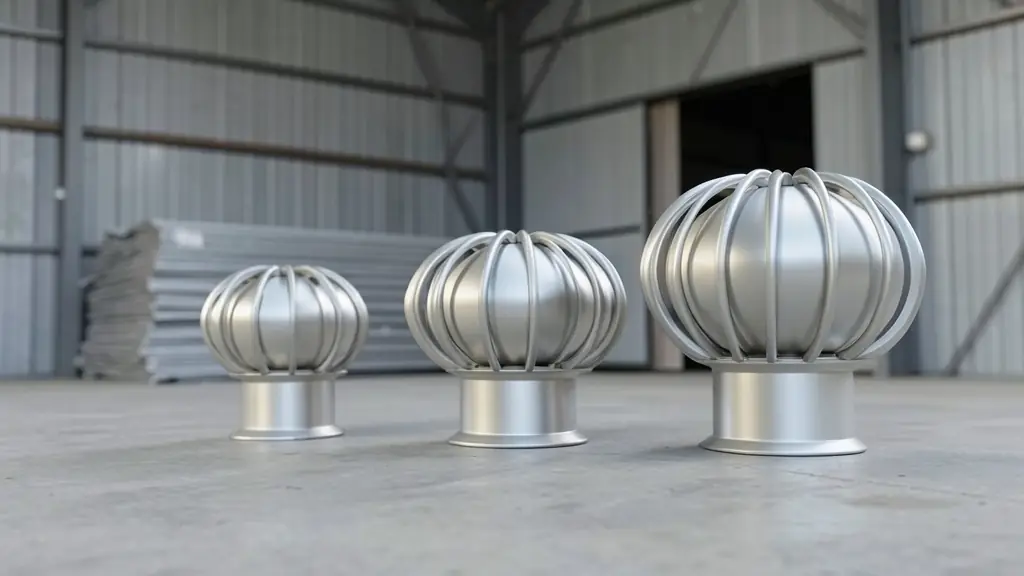
Whirlybird vent sizes are named by the throat, the round opening that goes through the roof, not by the width of the head. A 300 mm whirlybird has a 300 mm throat; the vaned head above it is wider. Common sizes run from about 150 mm up to 600 mm. Picking one is about how much air the roof space needs to lose, how windy the site is and how many holes you want to cut. Getting it wrong usually means too few heads, not the wrong size.
The common sizes and where each goes
| Throat | Typical place |
|---|---|
| 150 to 200 mm | Garden sheds, wendy houses, a garage, a small bathroom roof |
| 250 to 300 mm | Most house roof spaces, two to four heads |
| 350 to 400 mm | Large houses, double garages, small workshops and halls |
| 450 to 600 mm | Factories, warehouses and farm sheds, in rows |
These are rough guides, not rules. The whirlybird calculator works from your own roof area.
Why the airflow figure always has a wind speed
A turbine moves more air the harder the wind blows. That is why a maker's data sheet quotes extraction in m³/h at a stated wind speed, often a fresh breeze. Compare two heads at the same speed or the comparison means nothing. A sheltered roof in a leafy Johannesburg suburb sees far less wind than a farmhouse on the open Free State plains, so the same head does less work there. Be wary of a quote that lists a big airflow with no wind speed beside it, and ask the supplier to send the data sheet before you order.
One large head or two small ones
On a house, two 300 mm heads usually beat one 450 mm. They spread the draw along the roof, so you do not get one hot corner, and a smaller hole is easier to flash on tiles. One large head makes sense on a short shed or where only one spot near the ridge is clear of trusses, panels and the geyser. On a factory, rows of 600 mm heads keep the hole count down. See industrial turbine ventilators.
Head height and throat extensions
A head sitting low in the lee of a ridge or a double storey wall catches little wind. A throat extension lifts it into moving air; ask for one where a turbine sits on a lower roof beside a taller one. Longer extensions need bracing. The base still has to match the roof, see installation.
What to put in your request
- Give the ceiling area of the roof space in m²
- Say which throat size you think you need
- Note any lower roof sitting beside a taller one
- Ask for the airflow at the same wind speed
- Say how many old heads are being replaced
Turbine Ventilator Sizes: who asks for them and why
- Homeowners and DIY: the right throat for a single storey roof, a double storey or a separate garage
- Roofers and roofing contractors: sizes and counts worked out per roof before the sheets go on
- Builders, developers and architects: one head size written into the spec so every unit on the site matches
- Factories, warehouses and workshops: large throat heads in rows to keep the number of holes in the sheeting down
- Offices, shops, restaurants and gyms: medium heads over a shop, a gym or a restaurant dining room
- Farms, poultry houses and packsheds: big heads on a long implement shed and small ones on a pump house
- Schools, clinics, churches and halls: a size chosen for a school hall or clinic roof by its volume
- Landlords, body corporates and estate managers: a standard replacement size stocked for all the townhouses in a complex