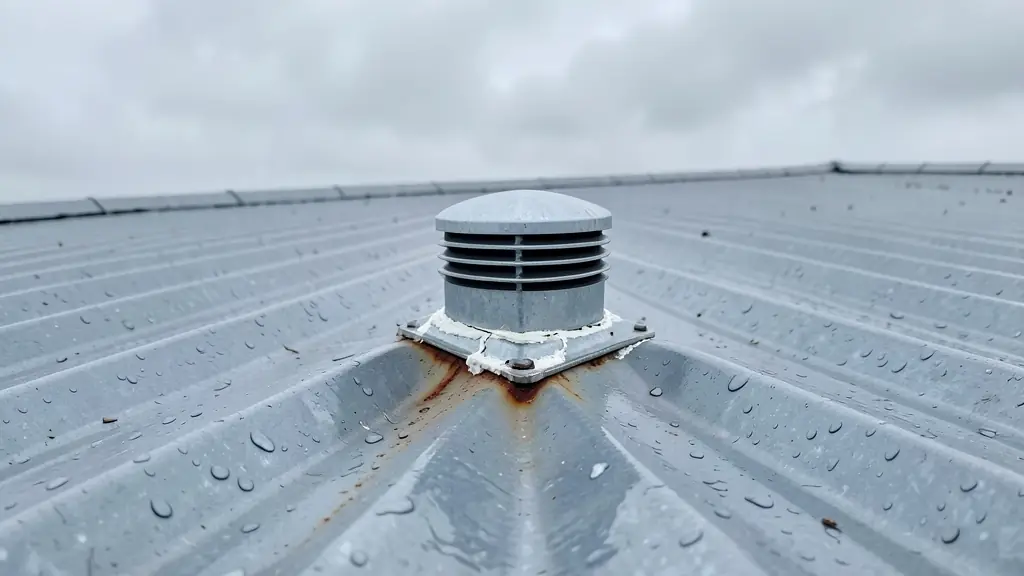
Most roof vent leak repair jobs are not about the vent at all. The turbine head or the pipe cap is usually fine. The water gets in round the base: sealant that has cracked in the sun, a flashing that lifted in a storm, or a base that never matched the sheet profile. Finding the exact entry point matters, because a fresh smear of silicone over the wrong spot buys a few weeks and hides the real fault from the next roofer.
Where the water gets in
- Cracked or shrunk sealant after a few summers of UV on a north facing slope.
- A lifted flashing after wind got under its edge.
- The wrong base. A flat base on IBR ribs leaves gaps that sealant alone cannot bridge.
- Too low a pitch. Water backs up behind a turbine on a near flat roof.
- Driving rain blown through the vanes of a head in a Cape winter northwester.
- A missing collar where a vent pipe passes through the sheet.
How a roofer traces it
A good roofer starts inside: the stain on the ceiling, then the wet trail on the truss or the underside of the sheet, which may run a metre or two from the vent. On the roof they check the sealant, the fixings and the upslope side of the base, where water piles up. A hose test, run slowly from below the vent upward, shows the spot without guessing. Ask for photos of what they find.
Reseal, reflash or replace the base
Old sealant is cut away and the metal cleaned before new goes on; sealant over sealant fails. Where the flashing has lifted or torn it is refitted or renewed. Where the base was wrong for the profile, the honest fix is a new base cut for that sheet. On concrete or clay tiles, a soft flashing dressed into the tile shape usually replaces a cracked mortar fillet. An old grey fibre cement roof may be asbestos: leave any cutting, drilling or grinding on it to a registered asbestos contractor. See whirlybird installation for how a base should go on.
The sealant matters
Ordinary bathroom silicone does not bond well to galvanised steel and breaks down in the sun. Roofers use a polyurethane roof sealant or a sealant the sheet maker approves, often with a butyl tape under the flashing. Check the roof before the rains: November on the Highveld, April in the Western Cape.
What to put in your request
- Say how many vents leak and which type
- Name the roof covering and its age
- Say whether it leaks in all rain or only storms
- Send a photo of the ceiling stain and the vent
- Ask for a guarantee on the repair
Roof Vent Leaks: who asks for them and why
- Homeowners and DIY: a brown ring on the ceiling under a turbine that appears after every storm
- Roofers and roofing contractors: tracing a leak to a flat base on IBR ribs and quoting the right base
- Builders, developers and architects: snag lists on a new build where vents were sealed in a hurry
- Factories, warehouses and workshops: water on the floor of a warehouse under a row of old turbines
- Offices, shops, restaurants and gyms: a restaurant cowl or shop vent dripping onto counters in heavy rain
- Farms, poultry houses and packsheds: rusted bases on an old shed roof letting rain onto feed and tools
- Schools, clinics, churches and halls: classroom ceilings stained round vent pipes before the rainy season
- Landlords, body corporates and estate managers: one contractor resealing every vent in a complex before the rains