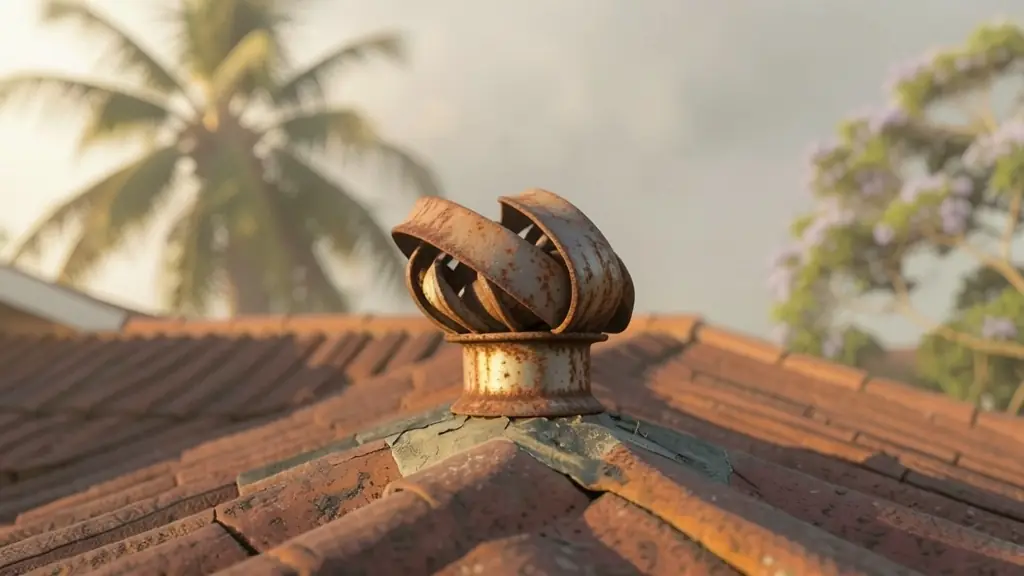
A whirlybird making noise is nearly always telling you something specific. A high squeal or grinding means a dry or worn bearing. A rhythmic knock means a bent vane or a tilted head. Silence and no spin means a seized bearing or a nest. A brown ring on the ceiling under it means the base has let water in. Most of these are cheap to fix if caught early, and most turn into a new head if left for another season.
The usual faults
- Worn bearings: squealing at night, grinding in strong wind, then a head that stops altogether.
- A bent vane after hail, a falling branch or a ladder: the head turns unevenly and clatters.
- The head not level: a base that settled or was never set plumb wears one side of the bearing.
- Dried sealant or a lifted flashing: drips on the ceiling in driving rain.
- Rust on old galvanised heads, worst at the coast.
- Birds and nests in the throat, and wind damage after a Highveld storm.
Bearing, head or the whole unit
On many heads the bearing can be swapped if the vanes are straight and the metal sound; that is the cheapest fix. If vanes are bent, torn or rusted through, a new head on the existing base is the next step, but only if the throat size matches. If the base is rusted, the flashing cracked or it was the wrong base from the start, replace the whole unit and reseal. Leaks get their own page: roof vent leaks.
Who repairs it and what to tell them
A roofer or a ventilation installer. Tell them the throat size if you know it, the roof covering, how many heads are faulty, the sound or symptom and when it started, and send a photo from the ground. On a body corporate, list every unit with a problem so it is one call out. The older heads may need swapping for current sizes.
A quick check after a storm
From the garden, look at each head: upright, round and turning with the others? Inside, check the ceiling under each one for a stain. Do not climb onto a wet roof to look closer; leave that to the roofer with a harness. Note which heads have stopped while the rest spin, because a lone still head after hail usually means a jammed bearing or a dent touching the neck. A quick photo of each from the same spot each year shows a slow tilt you would otherwise miss. On a Fourways complex with forty units, a trustee walking the roads with a phone after a storm finds most faults in half an hour.
What to put in your request
- Describe the noise or fault and when it started
- Send a photo of the head taken from the ground
- Give the throat size if you know it
- Say how many heads need attention
- Mention any stain on the ceiling below
Whirlybird Repairs: who asks for them and why
- Homeowners and DIY: a head that squeals over the main bedroom at night or drips in a storm
- Roofers and roofing contractors: a bearing swap or a reseal added while on the roof for another repair
- Builders, developers and architects: snags fixed on a new house where a head was fitted crooked
- Factories, warehouses and workshops: rusted or seized heads on a factory roof replaced in one shutdown
- Offices, shops, restaurants and gyms: a noisy turbine over a restaurant, a salon or an office fixed after hours
- Farms, poultry houses and packsheds: nests cleared and bent vanes replaced on sheds and stores after hail
- Schools, clinics, churches and halls: a clattering head over a classroom or church hall repaired before term
- Landlords, body corporates and estate managers: a list of faulty heads across a complex handled in one call out
Frequently asked questions
Can I just oil a squeaking whirlybird?
Why is my whirlybird not spinning?
Is it worth repairing an old galvanised whirlybird?
Do you repair whirlybirds?
Work it out first
- Roof vent area calculatorCeiling area in, the net free vent area and the eave and high vents to fit out
- Whirlybird calculatorRoof size and turbine size in, how many whirlybirds and the eave intake out
- Air changes calculatorBuilding size and use in, the airflow in m³/h and how many fans or turbines out