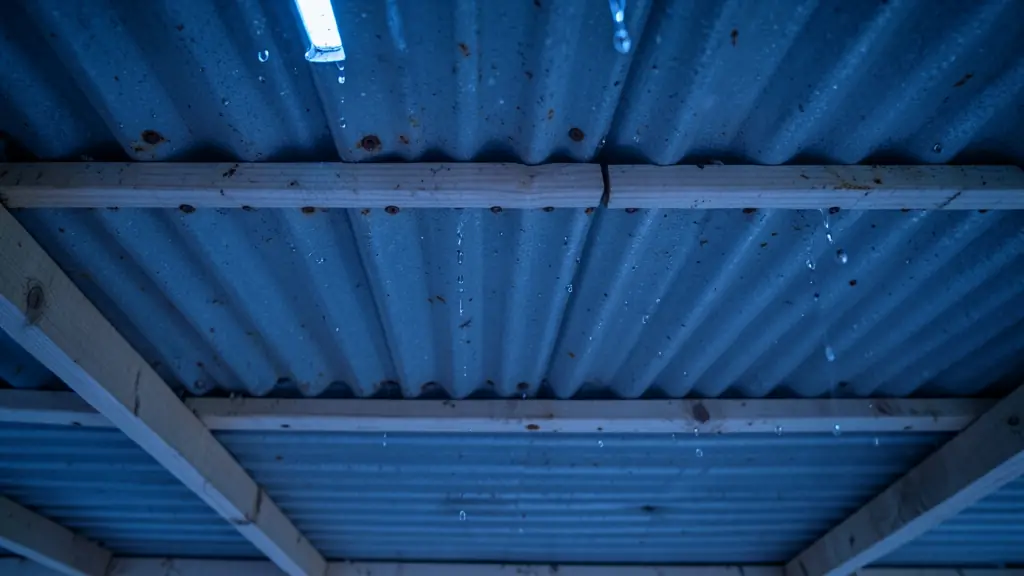
Roof condensation is the "leak" that appears on a clear winter morning when it has not rained for weeks. Warm, moist air from the house rises into the roof space, meets a steel sheet that cooled overnight under a clear sky, and the water comes out of the air onto the sheet. Then it drips onto the ceiling boards, soaks the insulation and rusts the screws. Ventilation helps, but it is only one of the fixes, and not always the first one.
How to tell it from a real leak
A leak follows rain and usually shows in one place. Condensation shows after cold, clear nights, often in July in Johannesburg or Bethlehem, and it spreads: drops along every sheet, damp patches near downlights, a musty smell. Look up into the roof space early in the morning with a torch from the trap door. Wet sheets all over, with dry skies outside, point to condensation.
Where the moisture comes from
- Hot showers in a bathroom with no extractor, or with a fan that blows into the roof space instead of outside.
- Cooking without a ducted hood.
- Unflued gas heaters, which put out a lot of water vapour as they burn.
- Drying washing indoors in winter.
- Open downlights and gaps around the trap door that let house air straight up.
A bathroom extractor ducted to a roof cap, not into the void, is often the single biggest change.
The fixes, in order
- Cut the source. Use lids, duct the fans out, avoid unflued heaters where you can.
- Seal the ceiling. Close gaps around downlights, pipes and the trap door.
- Ventilate the roof space. Intake at the eaves and exhaust high, so damp air is replaced before it settles. The roof vent area calculator gives the open area to aim for.
- Fix the sheet. On a reroof, sarking or an anti condensation layer under the sheets stops drops reaching the ceiling.
- Insulate. Insulation keeps the rooms warm; it does not dry the roof, which is why the steps above come first.
When it is a complex, not one house
A body corporate in Fourways with forty garages under bare IBR will see drips on every car on the same morning. A clear pattern like that is worth one specification for the whole complex: eave intake, a turbine or ridge vent per garage and an anti condensation layer at the next reroof.
What to put in your request
- Say when the drips appear: mornings, winter
- Name the roof covering and whether there is sarking
- List gas heaters, showers and where fans vent
- Attach a photo from inside the roof space
- Say if it is one house or a complex
Roof Condensation: who asks for them and why
- Homeowners and DIY: drips on the ceiling on clear winter mornings with no rain in sight
- Roofers and roofing contractors: explaining to a client that the leak call out is really condensation
- Builders, developers and architects: specifying sarking and roof space vents so a new steel roof stays dry
- Factories, warehouses and workshops: stopping water dripping from warehouse sheets onto stock and machines
- Offices, shops, restaurants and gyms: a gym or laundry where steam meets a cold steel roof every morning
- Farms, poultry houses and packsheds: sweating sheets over a feed store or a dairy where moisture is constant
- Schools, clinics, churches and halls: a school hall or clinic ceiling stained from years of winter drips
- Landlords, body corporates and estate managers: rows of townhouse garages dripping on cars on the same cold morning