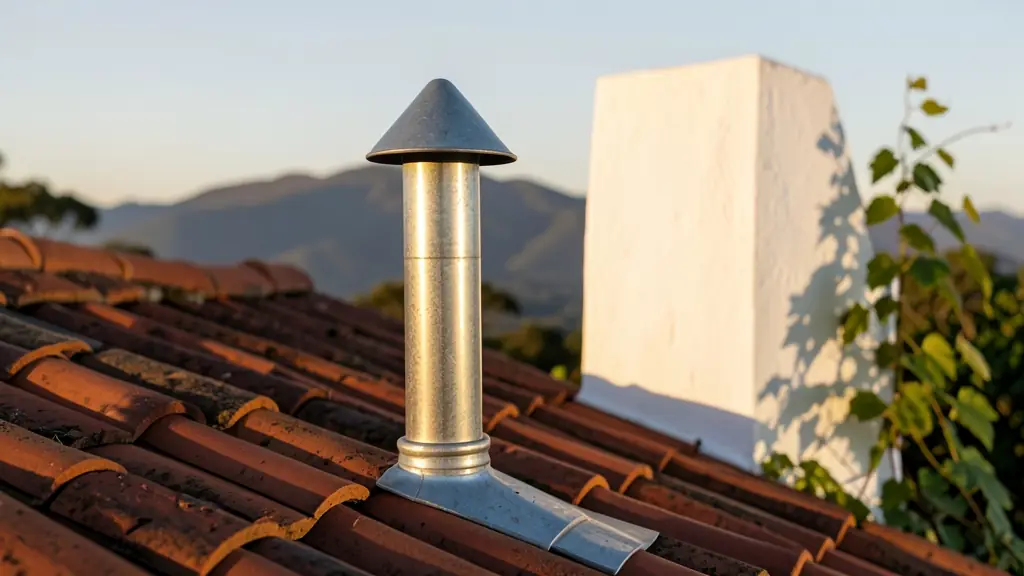
A roof vent for a range hood is the outlet that takes cooking steam, smoke and grease from your cooker hood up a duct and out through the roof. It is the fix when the stove stands on an inside wall, or under a second storey, and there is no outside wall within a short run. Done well, the kitchen in a Stellenbosch cottage stays clear on a braai night; done badly, grease and steam end up in the roof space. Here is how to plan it.
Ducted or recirculating
A recirculating hood pulls air through a grease filter and a charcoal filter and blows it back into the kitchen. It catches some smell but leaves the heat and the moisture in the room. A ducted hood sends everything outside, which is what you want over a gas hob, a wok burner or an indoor braai. Many hoods can be set up either way, so check which one you have before ordering a vent. Microwaves with a built in fan above the stove are usually weak extractors, even when ducted.
The duct run
- Size: keep the duct at least as wide as the hood's outlet, never smaller. A reducer chokes the fan and makes it louder.
- Length and bends: the shorter and straighter the better. Each elbow costs airflow, so two gentle bends beat four sharp ones.
- Material: smooth rigid metal duct where you can, flexible foil only for short connections. Ribbed flex collects grease.
- Insulation: wrap the duct where it crosses a cold roof space so steam does not condense and drip back into the hood.
The extractor fan size calculator suggests an airflow and duct size for the kitchen.
The outlet on the roof
The duct ends in a cowl or a vent cap with a backdraft flap, so wind and rain do not blow down into the hood when it is off. On concrete or clay tiles a roofer often uses a pipe adaptor vent tile or a lead or soft flashing around the pipe. On IBR or corrugated sheeting the pipe passes through a flexible flashing boot that is sealed and screwed to the sheet. Never stop the duct in the ceiling void: the greasy steam settles on the roof sheets, the timber and the insulation.
Grease, fire and commercial kitchens
Grease builds up in ducts and is a real fire risk, so clean or replace filters regularly and keep the duct away from thatch and timber. A restaurant or takeaway canopy is a different job: it needs a specialist kitchen extraction contractor, fire rated ductwork, access panels for cleaning, and often local authority approval.
What to put in your request
- Give the hood type and its outlet size
- Say how far the stove is from the roof
- Name the roof covering: tiles or sheeting
- Mention a gas hob, wok burner or indoor braai
- Say if a ceiling or cupboard must be opened
Kitchen Roof Vents: who asks for them and why
- Homeowners and DIY: ducting an island hood up through the ceiling and out through a tiled roof
- Roofers and roofing contractors: cutting and flashing a cowl for a hood duct on tiles or IBR during a renovation
- Builders, developers and architects: planning the hood duct route and roof outlet before the ceilings go up
- Factories, warehouses and workshops: a staff canteen hood in a factory ducted out through the sheeting
- Offices, shops, restaurants and gyms: a small coffee shop or deli hood, with full canopies passed to a specialist
- Farms, poultry houses and packsheds: a farmhouse kitchen or a lapa braai area that fills with smoke
- Schools, clinics, churches and halls: a school or church hall kitchen used for functions and fundraisers
- Landlords, body corporates and estate managers: a standard roof outlet detail for kitchens across a new complex